Rediscovering the biblical pattern
Ekklesia. Called out. Gathered in homes. Built up in love.
The early Christians met in ordinary homes for a simple, powerful reason: to build one another up. What if we returned to that?
Join thousands rediscovering the ekklesia
THE WORD MATTERS
What is Ekklesia?
The New Testament uses one specific Greek word for the gatherings of believers. It is not the word most English Bibles translate as “church.”
ἐκκλησία
ek-klay-SEE-ah
ἐκ (ek) — “out of” or “from”
καλέω (kaleō) — “to call”
Literal meaning: A called-out assembly or gathering of those summoned.
In the New Testament, ekklesia refers to the people God has called out of the world and gathered together — first in Jerusalem, then in homes across the Roman world.
A TRANSLATION CHOICE
Where did “church” come from?
The English word “church” does not come from ekklesia. It traces back through Old English cirice to the Greek kyriakon — “belonging to the Lord” or “Lord’s house.” Over time, the focus shifted from the people to a building or institution.
Why it matters: Recovering “ekklesia” helps us see the church as a living, relational body rather than a place we go or an organization we join.
THE BIBLICAL PATTERN
It Started - and Thrived - in Homes
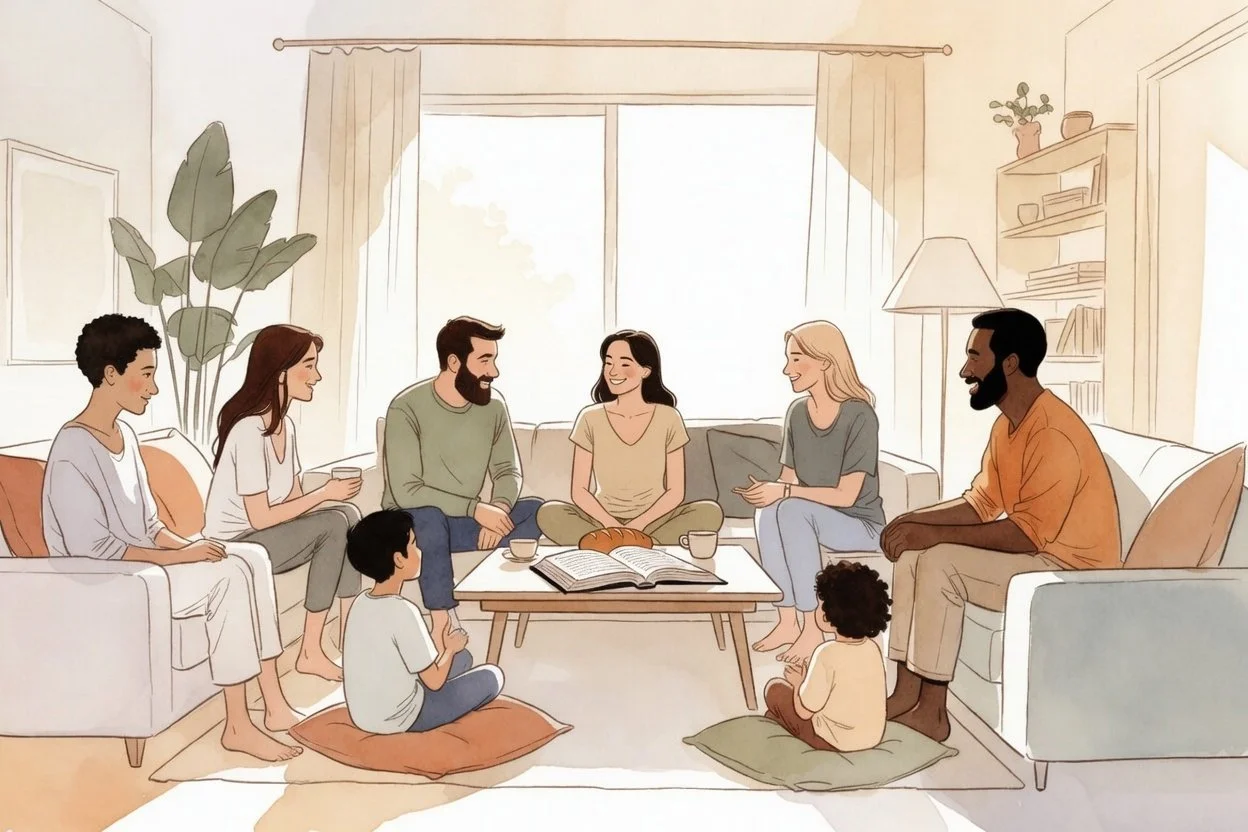
The earliest gatherings were not centered around specialized religious buildings. They met around tables, in households, and in ordinary rooms where everyone could participate.
Explicit “church in the house”
Romans 16:5 — "the church in their house" (Priscilla & Aquila)
1 Corinthians 16:19 — same household
Colossians 4:15 — "the church in her house" (Nympha)
Philemon 2 — "the church in your house"
House-to-house rhythm
Acts 2:46 — "Day by day continuing with one mind in the temple, and breaking bread from house to house..."
Acts 5:42 — "Every day in the temple and from house to house, they did not cease teaching and preaching Jesus as the Christ."
Acts 20:20 — Paul taught "publicly and from house to house."
Why homes?
Homes provided natural hospitality, intimacy, and participation. Everyone could contribute. Relationships formed around tables, not stages.
The setting itself encouraged the "one another" life the New Testament commands.
THE PRIMARY PURPOSE
Build One Another Up
The gathering was not primarily a weekly event performed by a few for many. It was a participatory assembly where each person could bring something for the strengthening of the body.
"What then, brothers? When you come together, each one has a hymn, a teaching, a revelation, a tongue, or an interpretation. Let all things be done for building up."
— 1 Corinthians 14:26 (ESV)
Teaching and exhortation
Instruction was shared for maturity, correction, encouragement, and obedience.
Bread, prayer, and fellowship
The table and the gathering belonged together: shared life, shared food, shared prayer.
Mutual participation
The body was built up as each member contributed what the Spirit had given.
TRACE THE PATTERN
Key Scriptures
The New Testament gives a consistent picture: believers gathered in homes, shared life, and practiced mutual edification.
Homes and households
Acts 2:46 • Romans 16:5 • 1 Corinthians 16:19 • Colossians 4:15 • Philemon 1:2
Mutual building up
1 Corinthians 14:26 • Ephesians 4:11–16 • Hebrews 10:24–25 • 1 Peter 4:10–11
Shepherding and maturity
Acts 20:17–35 • Titus 1:5–9 • 1 Timothy 3:1–7 • 1 Peter 5:1–4
Witness and multiplication
Matthew 28:18–20 • Acts 5:42 • Acts 8:4 • Acts 20:20
Ready to Plant an Ekklesia?
Begin simply: gather believers around Scripture, prayer, a shared meal, and the commitment to build one another up in love.
01. Invite a few faithful households.
02. Let Scripture shape the meeting.
03. Make mutual edification the aim.